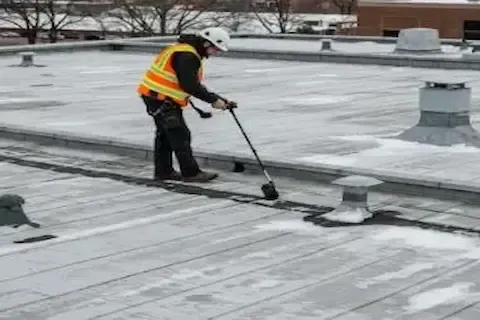
Commercial Roof Inspection in Woodbury MN Year Round
Flat and low-slope commercial roofs in Woodbury, Minnesota face a genuinely demanding annual cycle. From subzero January cold snaps that contract membrane seams to the hail-producing supercells that roll across Washington County every spring, from the UV saturation of August to the freeze-thaw whiplash of October and November, a commercial roof here absorbs stresses that a roof in a milder climate simply never encounters. A structured, year-round inspection program is not optional maintenance — it is the primary tool that keeps those stresses from turning into interior water damage, disrupted operations, and premature membrane replacement.
Why Year-Round Inspection Matters for Commercial Properties in Woodbury
Many building owners assume a single annual inspection is sufficient. For light residential roofing that logic has some merit, but for commercial low-slope systems covering warehouses, medical clinics, retail centers, and office buildings along corridors like Radio Drive and Hudson Road, one inspection per year leaves long windows of exposure. A seam that begins lifting in February can admit melt water by March, saturate insulation through April, and compromise a deck section before anyone notices visible ceiling staining in June. By that point, what was a two-hour repair has become a five-figure remediation.
Year-round inspection means building a calendar-based program that catches vulnerabilities at each seasonal transition, supplements that calendar with event-driven checks after significant weather, and maintains documentation detailed enough to satisfy manufacturer warranties and insurance carriers. When you work with qualified Commercial Roof Inspection professionals in Woodbury, that documentation becomes a running asset record rather than a stack of disconnected service invoices.
The Four Seasonal Phases and What Each One Demands
Winter: Load, Contraction, and Drainage
Minnesota winters regularly push Woodbury commercial roofs to their design limits. Snow accumulation loading is the most visible concern, but thermal contraction is often the more damaging force. TPO and EPDM membranes shrink measurably when temperatures drop below zero, placing stress on field seams, perimeter edge metal, and penetration flashings around HVAC curbs and exhaust stacks. Pre-winter inspection — ideally completed in October before the first hard freeze — should verify that all heat-welded or adhesive seams are fully bonded, that edge metal terminations are tight, and that interior drains are cleared of debris. Mid-winter walkthroughs after heavy snowfall focus on load distribution, checking that drifting has not created pockets exceeding design load and that any mechanical snow removal has not scored or punctured the membrane surface.
Spring: Melt, Runoff, and Hidden Damage Assessment
The spring thaw in Washington County is when latent winter damage reveals itself. Ice dams at parapet walls can force water under flashings that appeared intact all winter. Saturated insulation does not always show obvious surface indicators; a core pull test during spring inspection is the reliable way to measure moisture content and map wet zones before they spread. Spring is also when hail season begins, and even small-diameter hail can create hairline cracks in aged TPO that are nearly invisible at ground level but leak under standing water. A thorough post-winter inspection in April or early May positions you to address those findings before summer heat cycles begin accelerating membrane aging.
Summer: UV Exposure, Thermal Cycling, and Equipment Activity
Commercial roofs in Woodbury absorb intense solar radiation through June, July, and August. Dark-colored EPDM membranes in particular experience significant surface temperatures on clear days, and even reflective TPO membranes undergo repeated daily thermal expansion and contraction cycles that stress penetration flashings and field seams over time. Summer is also when HVAC technicians, communications crews, and other trades access rooftops most frequently, and foot traffic without proper walk pads creates puncture and abrasion risks. A midsummer inspection checks for blistering, surface crazing, improperly replaced walkway pads, and new penetrations that were made without proper counter-flashing. It is also the right time to photograph drainage patterns while afternoon thunderstorms are frequent, identifying any low spots that are holding water beyond the 48-hour drainage standard.
Fall: Preparing the Roof for Winter Stress
October and November in the Twin Cities metro deliver some of the most volatile weather of the year — rain, wet snow, freeze-thaw cycles that can occur within 24 hours, and wind events associated with departing fall storm systems. Fall inspection is the last planned opportunity to address anything before winter locks down repair windows. Priorities include clearing all drains and gutters, inspecting termination bars and counter-flashings at parapet walls, checking expansion joint covers for material deterioration, and verifying that any repairs made over the summer have cured properly and remain bonded under early freezing conditions. For buildings with rooftop mechanical equipment along commercial corridors like Valley Creek Road or near the Woodbury Lakes retail area, fall inspection should also confirm that condenser drain lines serving HVAC units are properly routed away from membrane field areas.
Event-Driven Inspections: When the Calendar Is Not Enough
Severe weather in Washington County does not follow a schedule. Hailstorms, straight-line wind events, and heavy rain episodes can occur at any point in the spring, summer, or early fall. A written inspection policy for commercial facilities should define trigger thresholds — for example, any reported hail event of one inch diameter or larger, any wind event with gusts exceeding 60 mph, or any rainfall accumulation exceeding three inches in a 24-hour period — that automatically generate a post-event inspection within 48 to 72 hours. Insurance carriers increasingly require documented post-storm inspections as a condition of claims, and having a responsive inspection partner who can mobilize quickly after a storm means you can meet those documentation requirements before evidence degrades.
Interior water intrusion reports also warrant immediate inspection response. When a tenant or building manager reports active ceiling staining or dripping during a rain event, a reactive inspection should occur as soon as weather conditions safely permit access. Delays between intrusion and inspection allow water to migrate laterally through insulation layers, making the source identification process significantly more complex.
Membrane-Specific Considerations for TPO and EPDM Systems
The majority of commercial flat roofs installed in the Woodbury area over the past two decades use either TPO or EPDM membranes, each with distinct inspection priorities. Understanding the differences helps building owners ask the right questions and evaluate inspection findings accurately.
TPO membranes are heat-welded at seams, and those welds are the primary failure point as systems age. Inspection of a TPO roof should include a hands-on probe of welded seams to check for delamination, examination of the weld width using a probe tool to confirm penetration, and close inspection of all T-joints where multiple seam directions converge — a historically vulnerable geometry. TPO field surfaces can also develop surface erosion and discoloration that indicates UV breakdown, and while surface chalking alone does not indicate failure, it signals that the membrane is entering a more vulnerable phase of its service life.
EPDM inspection priorities differ. Because EPDM seams use adhesive bonding rather than heat welding, lap seam integrity depends on adhesive condition and surface contamination history. Over time, seam edges can lift or develop voids, especially at inside corners. EPDM flashings around penetrations are also a common inspection focus because the cured rubber can crack or pull away from the substrate as it ages. For building owners with ballasted EPDM systems, reviewing ballasted EPDM install methods provides useful context on how ballast migration over time can expose membrane field areas and reduce wind uplift resistance.
Warranty Compliance and Documentation Standards
Most manufacturer warranties for commercial roofing systems in the 15 to 30-year range carry maintenance requirements that must be documented to keep the warranty valid. These requirements typically specify minimum inspection frequency, approved repair procedures and materials, and notification timelines when significant damage is discovered. Failing to maintain inspection records does not automatically void a warranty, but it places the burden of proof on the building owner when a claim is filed. A thorough inspection program that generates timestamped written reports with photographs creates a continuous record that supports warranty claims and provides clarity in insurance disputes.
For commercial properties in Woodbury that are managed by property management companies or held in investment portfolios, standardized inspection documentation also serves asset management functions — providing data for capital expenditure forecasting, supporting due diligence during property transactions, and satisfying lender requirements for commercial real estate financing.
Choosing an Inspection Provider for Woodbury Commercial Properties
Not every roofing contractor who offers inspections has the training, tools, or documentation practices to support a genuine year-round program. When evaluating inspection providers for your Woodbury commercial facility, look for contractors who carry membrane-manufacturer certifications relevant to the system type on your building, who use infrared scanning or electronic leak detection tools as part of their assessment methodology, and who produce written reports with condition mapping rather than simple pass-fail checkboxes. Local knowledge matters as well — a provider familiar with Washington County weather patterns, the specific drainage challenges common to buildings in the Woodbury commercial zones, and the permit and inspection requirements for repair work in the city will provide more actionable assessments than a generalist firm with no local context.
Building a Long-Term Roof Asset Strategy
A commercial roof is a capital asset with a measurable service life, and inspection data collected consistently over years transforms from maintenance records into forecasting tools. When you can chart membrane condition trends across multiple inspection cycles, you can project with reasonable accuracy when a full replacement will be needed, what intermediate repairs will extend useful life, and how those costs should be provisioned in your capital budget. That level of planning eliminates emergency replacement scenarios where a sudden catastrophic failure forces rushed procurement decisions under financial pressure.
For Woodbury building owners and property managers who want to protect their roof investment, move away from reactive maintenance, and meet warranty and insurance documentation requirements, a structured year-round commercial roof inspection program is the foundation. The seasonal stresses that Minnesota places on flat roofing systems are significant, but they are also predictable — and predictable stress is manageable when you have the right inspection framework in place.
