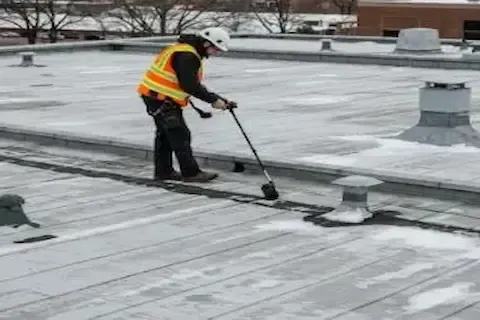
Pre-Winter Commercial Roof Checks for Woodbury Buildings
Woodbury winters don't ease into the season. By November, flat and low-slope commercial roofs across the city are already facing freeze-thaw cycles, early snow accumulation, and the kind of standing water that turns into something far more damaging overnight. A pre-winter commercial roof inspection is not a precaution for cautious property managers — it's the difference between a manageable repair bill in October and an emergency call in January when a seam fails under twelve inches of wet snow.
What Pre-Winter Inspections Actually Cover
A thorough pre-winter inspection goes well beyond a visual scan from ground level. A qualified inspector moves across the entire field of the roof and evaluates every component that interacts with cold, moisture, and weight. For Woodbury commercial properties, that typically means examining membrane conditions on TPO, EPDM, or modified bitumen systems, checking all flashing terminations at parapets and curbs, probing seams and laps for delamination, and clearing every interior drain, scupper, and overflow outlet.
Drain blockages are among the most common findings on pre-winter inspections in this region. Debris from fall tree activity accumulates quickly, and even a partially blocked drain can hold several inches of water that freezes solid when temperatures drop. That ice load presses against seams and membrane edges in ways that accelerate deterioration and can force water under flashing during the next thaw.
Why Woodbury's Climate Creates Specific Risk Factors
Woodbury sits in Washington County where Lake St. Croix air patterns interact with metro cold fronts, producing a freeze-thaw cycle that can run multiple times per week during the shoulder months of November and March. This isn't a region where snow falls and stays frozen until spring. The temperature swings through late fall mean that water infiltrating a small seam flaw in October will have expanded and contracted dozens of times before a building owner notices interior ceiling damage in February.
Flat and low-slope roofs on Woodbury office parks, retail centers, and industrial buildings are especially vulnerable to this cycle because standing water has nowhere to drain quickly when outlets are compromised. The older commercial corridors along Valley Creek Road and Bielenberg Drive include buildings with roof systems that have been patched over multiple cycles without a comprehensive evaluation of the membrane substrate beneath those patches.
Loose Flashing: The Repair That Avoids the Replacement
Flashing failures are responsible for a disproportionate share of winter water damage in commercial buildings. Flashing at HVAC curbs, skylights, parapet walls, and penetrations is the boundary between a watertight system and an open pathway for moisture. When the sealant around these terminations ages, shrinks, or separates from the substrate, water can travel laterally under the membrane without producing an obvious surface leak until the damage is already extensive.
Pre-winter inspections catch loose flashing while re-securing it is still a straightforward, cost-controlled task. Once winter sets in, both access and material performance become more complicated. Many sealants have temperature minimums below which they will not adhere properly, which means a flashing repair attempted in January is often a temporary measure at best.
For an in-depth look at how Woodbury commercial roof inspections address these issues across all four seasons, a year-round inspection overview provides useful context on how pre-winter findings compare to what inspectors find in spring and summer assessments.
Seam Integrity Under Snow Load
Seams are the engineered joints in a membrane system, and they are the most mechanically stressed points on any flat roof. Heat-welded seams on TPO systems and fully adhered laps on EPDM both have a service life, and that life is shortened by UV exposure, thermal movement, and any intrusion of moisture at the seam edge. A seam that looks acceptable to the eye during a dry-weather walkover may show measurable separation when probed with the right tools.
Under snow load, even a partially separated seam becomes a leverage point. The weight of snow, combined with the expansion of any trapped moisture, can peel a compromised seam open in a single heavy snowfall event. Finding seam weaknesses in October or early November allows them to be addressed with proper materials under appropriate temperature conditions. Waiting until the first snow has already arrived narrows repair options considerably.
What Inspectors Look for on Woodbury Flat Roofs
Every pre-winter commercial inspection on a Woodbury property should produce a documented condition assessment that covers the following areas:
- Membrane surface: Blistering, ridging, surface erosion, and granule loss on modified bitumen systems
- Seams and laps: Separation, fishmouthing, and adhesion failures throughout the membrane field
- Flashing: Termination bars, counter-flashing, coping caps, and all penetration details
- Drainage: Interior drains, scuppers, overflow drains, and any areas where ponding was observed in previous seasons
- HVAC and equipment curbs: Sealant condition, pitch pocket maintenance, and condensation drainage routing
- Parapet walls: Coping condition, through-wall flashing integrity, and any vegetation or debris accumulation at the base
This documentation matters not only for repair planning but for warranty compliance on newer systems. Many commercial membrane warranties require documented annual or biannual inspections to remain valid. Skipping the pre-winter check can create a gap in that record that complicates future warranty claims.
Scheduling and Timing in the Woodbury Market
The practical inspection window in Woodbury runs from mid-September through mid-November. Earlier in that window, temperatures remain warm enough to execute any repairs identified during the inspection without material performance concerns. Later in the window, inspections are still valuable for documentation and triage, but repair scheduling becomes more constrained.
Commercial roofing contractors in the east metro area tend to see a compressed scheduling crunch in October as multiple property managers attempt to address the same pre-winter concerns simultaneously. Booking an inspection in September allows for a more deliberate repair process and often better pricing on labor and materials before peak demand sets in.
Scheduling a Commercial Roof Inspection before the first hard freeze gives you the clearest possible picture of your roof's current condition and the most options for addressing whatever the inspection uncovers.
Cost of Deferred Inspection vs. Early Action
The financial case for pre-winter inspections is straightforward. A drain clearing and minor flashing re-seal identified during an October inspection typically costs a fraction of the interior remediation, insulation replacement, and emergency membrane repair that results from a winter water intrusion event. Woodbury commercial buildings with flat roof systems over occupied tenant spaces carry additional liability if water damage interrupts tenants or damages inventory and equipment.
Pre-winter inspection costs are predictable and bounded. Emergency winter repairs are neither. Property managers who make pre-winter inspection a fixed item on the annual calendar consistently report fewer emergency calls, better warranty compliance records, and longer intervals between full roof replacements — outcomes that reflect directly on operating budgets over a ten to twenty year horizon.
