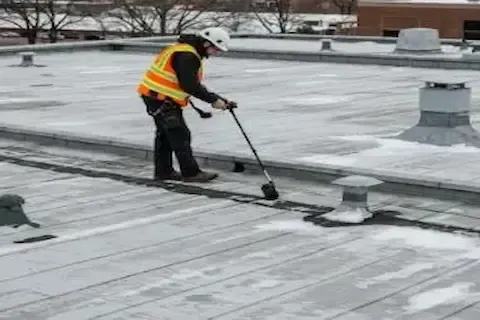
Post-Storm Commercial Roof Inspections in Woodbury MN
After a major storm moves through Woodbury, MN, a commercial roof inspection documents exactly what the storm left behind—hail strikes, wind-lifted membrane edges, displaced flashing, and debris punctures. That documentation is what drives insurance claims forward and tells your contractor where repairs need to happen. The process follows a clear sequence: exterior ground assessment, rooftop membrane and surface scan, drainage and flashing check, interior moisture survey, and written report with photos. Acting within 24 to 72 hours of storm passage gives you the strongest claim position.
Step 1: Conduct a Ground-Level Perimeter Assessment
Before anyone climbs onto the roof, walk the entire perimeter of your Woodbury commercial building. Look for granule accumulation in gutters and downspout splash zones—this is one of the clearest indicators of hail impact on modified bitumen or built-up roofing. Check for displaced coping caps, bent metal edge flashings, and debris piles against walls. Note any dented HVAC equipment, skylights with cracked glazing, or shattered roof-mounted lighting. Photograph everything at this stage. Ground-level evidence often corroborates rooftop findings and strengthens insurance documentation before an adjuster arrives.
Step 2: Perform the Rooftop Surface and Membrane Scan
A trained inspector surveys the field of the roof systematically, moving in overlapping passes to avoid missing sections. On flat TPO or EPDM membranes, hail strikes appear as circular stress marks, bruising, or outright punctures. On built-up roofing, look for fractured aggregate and exposed felts. Wind damage shows up as lifted seams, open laps, and membrane billowing near edges. Pay close attention to low-slope areas where ponding water may already be entering through compromised seams. Every impact point, lifted edge, and open seam gets photographed with a measurement reference in frame.
Step 3: Inspect Flashings, Drains, and Penetrations
Storm events routinely compromise the areas where the roof membrane meets vertical surfaces. Inspect all pipe boot flashings, HVAC curbs, parapet wall caps, and expansion joints. Wind can separate lap joints at these transitions even when the field membrane looks intact. Check roof drains for debris blockage—standing water accelerates damage and complicates insurance assessments. This is also the stage where Commercial Roof Inspection professionals use moisture meters or infrared scanning to identify wet insulation beneath the surface that storm infiltration may have already caused.
Step 4: Complete an Interior Moisture and Ceiling Survey
Damage visible on the rooftop does not always translate directly to interior locations due to the way water migrates through insulation layers. Walk the interior top floor of your Woodbury facility after the exterior inspection. Look for ceiling tile staining, rust streaks on metal deck, condensation on interior ductwork, or damp insulation visible where panels have shifted. Document every location with photos and GPS coordinates if your phone supports it. In warehouses and manufacturing spaces, this survey should extend to any rooftop mechanical rooms where water entry may be hidden behind equipment.
Step 5: Generate a Written Report Before Filing Your Claim
A verbal walkthrough is not enough. Your inspector should deliver a written report that includes storm date and weather data, a roof system description, itemized damage findings with corresponding photographs, and a repair scope. This report becomes your primary exhibit when working with your insurance adjuster. Adjusters operating in the Washington County and Woodbury market are familiar with storm patterns in the Twin Cities metro, but they rely on contractor-generated documentation to move claims through approval. Pair the inspection report with local weather records—hail reports from the Storm Prediction Center are publicly available and timestamp-verifiable.
Step 6: Arrange Emergency Tarping or Temporary Repairs if Needed
If the inspection reveals active water infiltration points—open seams, punctures, or missing flashing—temporary protection should be installed before the next rain event. Minnesota's shoulder seasons mean storms can arrive in close succession, particularly during spring and early fall in the Woodbury area. Emergency tarping or temporary membrane patches preserve your building and prevent secondary damage that insurers may argue was owner-preventable. Keep receipts and photos of any temporary work, as these costs are typically reimbursable under commercial property policies when documented properly. For background on how ongoing inspections fit into a broader maintenance strategy, review information on Woodbury commercial roof inspections throughout the calendar year.
