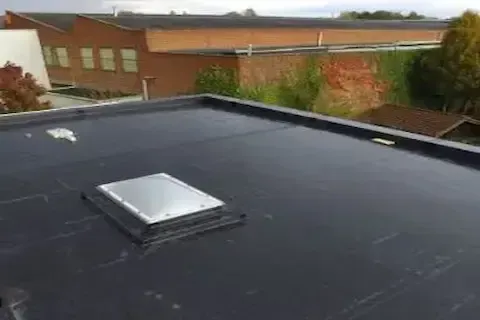
EPDM Seam Failures on Older Woodbury Minnesota Rooftops
Flat roofing systems in Woodbury, Minnesota face some of the harshest seasonal swings in the country. EPDM membranes installed ten, fifteen, or twenty years ago were built to last — but the seams holding those membranes together have a shorter clock. As temperatures swing from subzero January nights to humid July afternoons, the adhesives and tapes used to bond EPDM seams experience constant expansion and contraction stress. Over time, that stress accumulates into visible and structural failures that compromise your roof's ability to keep water out. Understanding exactly what EPDM seam failure looks like, why it happens on older systems, and what your repair options are can save you from a minor maintenance call turning into a full roof replacement.
What Makes EPDM Seam Bonds Deteriorate Over Time
EPDM rubber itself is remarkably durable. The membrane can survive UV exposure, temperature extremes, and minor foot traffic for decades. The weak point has always been the seams — the overlapping joints where one membrane panel connects to the next, typically bonded with either contact cement, seam tape, or a combination of both.
In the early to mid-2000s, solvent-based contact adhesives were the industry standard for EPDM seam bonding in the Woodbury area. These adhesives performed well initially, but their chemistry makes them vulnerable to long-term degradation. The solvents outgas over years, leaving behind a brittle adhesive layer that loses flexibility. Once flexibility is gone, the adhesive can no longer follow the membrane's natural movement during temperature changes. The result is delamination — the seam literally peels open along the bond line.
Seam tape products introduced in later years offered improved performance, but even tape-bonded seams are not immune. Older tape formulations lose their tack at the edges, and if moisture infiltrates the tape edge before the bond fully cures — a common problem during Woodbury's spring installation windows — the seam is compromised from day one, even if it looks fine on the surface for several years.
Diagnosing EPDM Seam Failures on a Woodbury Rooftop
Diagnosing EPDM seam failures is not always straightforward, because some failures are hidden under surface debris or only open under specific temperature conditions. A thorough inspection needs to account for multiple failure signatures.
The most obvious indicator is a visible split or gap along a seam line. You may see daylight between panels, or you may see the membrane edge lifted slightly away from the substrate. On older roofs in the Woodbury commercial district, these open seams are frequently found at perimeter edges and at transitions around rooftop HVAC equipment — areas where membrane movement is greatest.
A second indicator is surface blistering near a seam. When a seam bond fails, air and moisture can be trapped between the overlapping membrane layers. This moisture heats up during the day, creating a bubble or blister that may not be directly at the seam edge but runs along the bond line beneath the surface.
A third, less visible indicator is a dried adhesive line visible through the membrane surface. On older EPDM systems where solvent-based adhesives were used, the adhesive can shrink and pull away from the substrate. On white or weathered gray membrane surfaces, this sometimes appears as a faint shadow line — a ghost of the original seam position that has migrated slightly.
When inspecting, press along seam lines with firm hand pressure. A properly bonded seam should feel rigid and completely flush with no give. Any seam that flexes, springs back, or allows you to feel the edge lift has lost its bond integrity even if there is no visible gap yet. For a broader understanding of how these systems are constructed and where they are most vulnerable, reviewing Woodbury EPDM roofing options provides useful context on membrane types and installation standards.
Minnesota Climate Factors That Accelerate Seam Damage
Woodbury's climate is particularly hard on EPDM seam bonds for several compounding reasons. First, the temperature differential between summer highs and winter lows in the Twin Cities metro area routinely exceeds 120 degrees Fahrenheit across a calendar year. This forces the membrane and its seam bonds through thousands of expansion and contraction cycles over the roof's lifetime.
Second, freeze-thaw cycling is especially destructive to any seam that has already admitted even a small amount of moisture. Water that infiltrates a compromised seam edge in autumn will freeze during Woodbury winters, physically forcing the bond apart from the inside. By spring, what was a hairline separation has become a fully open seam.
Third, the heavy UV exposure during Minnesota summers degrades the surface of both the membrane and any exposed adhesive or tape at seam edges. UV degradation accelerates the brittleness of older adhesive compounds, speeding up the delamination cycle that cold weather then completes.
Repair Options for Failed EPDM Seams
The appropriate repair method depends on the extent of the failure and the overall condition of the surrounding membrane. Not every failed seam requires full membrane replacement, but not every seam can be effectively patched either.
For isolated seam failures where the surrounding membrane is in good condition, a lap seam repair using self-curing EPDM seam tape is the standard approach. The failed area must be thoroughly cleaned, the delaminated membrane edge re-set flat, and new seam tape applied with proper roller pressure to ensure full contact. This repair is durable when performed correctly, but it requires surface preparation that many property owners underestimate — contamination from oxidized membrane surface or old adhesive residue will cause the new tape bond to fail prematurely.
For seams where the membrane itself has become stiff, cracked, or has lost its elasticity around the seam zone, tape repair alone is not adequate. Stiff membrane cannot conform properly to the new tape surface, and the bond will not hold under thermal movement. In these cases, the failed seam section needs to be cut out and replaced with a new membrane patch that overlaps the existing membrane on all sides.
For roofs where seam failures are present at multiple locations — a common finding on Woodbury commercial buildings with EPDM systems installed before 2005 — full membrane replacement becomes the more cost-effective long-term solution. Addressing one seam while ignoring adjacent deteriorating bonds simply delays inevitable failures. A qualified contractor offering EPDM Roofing Systems services can evaluate whether your roof is a candidate for targeted repairs or whether a full replacement makes more financial sense over a five-to-ten year horizon. Where the failures are isolated rather than systemic, commercial roof repair in Woodbury addresses the affected seams and flashings without committing the building to a full membrane replacement.
What to Expect During a Professional Seam Inspection
A professional inspection of an aging EPDM roof in Woodbury should include both a visual survey and a physical probe of all accessible seam lines. Inspectors should check field seams, perimeter terminations, flashing seams around penetrations, and any T-joint intersections where three membrane layers meet — T-joints are historically the highest-failure locations on any EPDM system.
The inspector should document the number and location of failed or suspect seams and provide a written assessment distinguishing between seams that can be repaired and seams that indicate broader membrane degradation. Moisture readings with a non-destructive scanner can help identify wet insulation beneath the membrane that would need to be addressed before any seam repair is attempted.
Older commercial buildings along the Woodbury business corridors near Radio Drive and Valley Creek Road often have EPDM systems that have never received a comprehensive seam inspection. If your building's roof is approaching fifteen years or older, scheduling that inspection before the next freeze cycle is the single most protective step you can take against water intrusion this winter.
