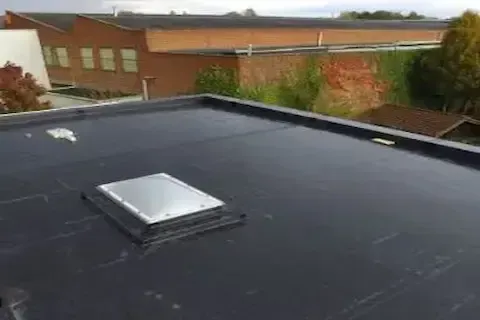
EPDM Roofing Systems for Woodbury MN Commercial Properties
Commercial property owners in Woodbury, Minnesota face a specific set of roofing challenges that most warmer-climate systems simply were not designed to handle. Freeze-thaw cycling, heavy snow loads, ice dam formation, and temperature swings that can span more than one hundred degrees between January and July all put enormous stress on low-slope and flat roof membranes. EPDM — ethylene propylene diene monomer — has been installed on commercial buildings across the Twin Cities metro for decades precisely because it performs well under those exact conditions. Before you make a decision about your next roof replacement or new construction membrane, it helps to understand what the material actually is, where it excels, where it has limitations, and what local installation factors separate a twenty-year roof from one that starts leaking in year four.
What EPDM Roofing Material Actually Is
EPDM is a synthetic rubber membrane derived from ethylene and propylene, two byproducts of the oil and natural gas refining process. The third component — diene monomer — introduces cross-linking sites that allow the material to vulcanize during manufacturing, creating a highly flexible, thermoset membrane. Unlike thermoplastic membranes such as TPO or PVC, EPDM cannot be re-melted and re-fused once it has cured. That distinction matters for both installation technique and long-term performance.
The membrane is produced in large factory rolls, typically in thicknesses of 45 mil, 60 mil, or 90 mil. Black is the standard color, though white EPDM membranes exist for projects where reflectivity is a priority. Black EPDM absorbs solar radiation rather than reflecting it, which produces a modest heating effect in winter months — a meaningful benefit in Washington County where rooftop temperatures in February can drop below negative twenty degrees Fahrenheit. The material remains flexible at extremely low temperatures, which is the core reason it has become a trusted choice for Minnesota commercial properties.
Three Installation Methods and How Each Performs
EPDM can be installed using three distinct attachment methods, and the method selected has a direct effect on long-term performance, wind uplift resistance, and cost. Understanding the differences helps you ask better questions when reviewing contractor proposals.
Fully adhered systems bond the membrane directly to a substrate using water-based or solvent-based bonding adhesive. The membrane lies flat against the insulation or cover board with no air movement underneath. Fully adhered installations tend to perform well in high-wind environments because there is no billowing or pressurization beneath the membrane. They also present a cleaner appearance and are easier to inspect for surface damage.
Mechanically attached systems use fasteners and steel or plastic plates to anchor the membrane at seams and field areas. This approach allows the membrane to float slightly between attachment points, accommodating thermal movement. Mechanically attached installations are generally faster to complete and cost less in labor, making them a common choice for large roof areas on office parks and retail centers throughout Woodbury. If you are evaluating membrane options beyond EPDM, you may also want to review information about mechanically attached TPO installs to understand how attachment philosophy differs between membrane types.
Ballasted systems lay the membrane loosely over insulation and hold it down with river stone or concrete pavers. Ballasted EPDM was extremely common on Woodbury commercial buildings constructed in the 1980s and 1990s. While the method is straightforward and allows easy membrane access, it adds significant dead load to the roof structure and is rarely specified for new construction today.
Seam Construction and Why It Determines Long-Term Performance
The most common failure point on any single-ply membrane roof is the seam, and EPDM seams require a different technique than TPO or PVC seams. Because EPDM is a thermoset material, it cannot be heat-welded. Seams are instead bonded using EPDM-specific seam tape or splice adhesive. Properly constructed EPDM seams using factory-manufactured tape products have decades of field performance data supporting their durability. Improperly constructed seams using undersized tape, contaminated surfaces, or inconsistent pressure during installation can fail within two or three years — often before the warranty period ends.
Temperature also affects seam installation quality. Many EPDM manufacturers specify minimum ambient temperatures during seam application, and working outside those windows produces inconsistent adhesion. In Washington County, commercial roofing seasons are compressed by cold weather, which puts schedule pressure on crews and increases the risk of seam quality shortcuts. A roofing contractor who installs year-round without adjusting technique for ambient temperature is a contractor worth questioning during the bid process.
EPDM Thickness Selection for Woodbury Commercial Buildings
Choosing between 45 mil, 60 mil, and 90 mil membrane comes down to application type, expected foot traffic, and budget. The 45 mil membrane is the thinnest commercially available specification and is appropriate for roofs with minimal maintenance traffic and no HVAC equipment requiring regular service access. It costs less per square foot but offers less puncture resistance and less dimensional stability over time.
The 60 mil specification is the most widely used thickness on Woodbury commercial properties, including office buildings, medical clinics, light industrial facilities, and HOA common buildings. It balances cost, puncture resistance, and long-term dimensional stability in a way that suits most low-slope applications. Most major manufacturer warranties for commercial EPDM are written around 60 mil membrane as the minimum specification.
The 90 mil membrane is specified for roofs with frequent foot traffic, rooftop gardens, utility access walkways, or situations where the owner wants the highest available durability margin. It is noticeably heavier and more challenging to handle during installation but offers a meaningful service life extension in demanding applications.
Insulation and Cover Board Compatibility
EPDM does not exist in isolation. The membrane performs only as well as the roof assembly beneath it, and insulation selection is a major part of that equation. Polyisocyanurate, commonly called polyiso, is the dominant insulation used under EPDM on Woodbury commercial roofs. It delivers high R-value per inch, which matters for meeting Minnesota energy code requirements. However, polyiso loses effective R-value at very low temperatures, a phenomenon called thermal drift. In Washington County winters, a roof assembly designed to meet code at standard temperature conditions may underperform in actual cold weather if the engineer did not account for thermal drift.
Cover boards — typically high-density polyiso, fiberglass-faced gypsum, or wood fiber board — are installed above the insulation layer to provide a stable, compressive-resistant substrate for the EPDM membrane. Cover boards matter enormously in mechanically attached and fully adhered systems because the membrane must bond or fasten to something that does not compress under foot traffic or equipment vibration. A roof assembly without a proper cover board often develops dimpling and indentations over time that accelerate membrane fatigue.
Roof Drainage Design on Minnesota Commercial Properties
EPDM membrane is only part of the story on any low-slope commercial roof. Drainage design determines how long that membrane stays in good condition. Standing water — ponding — is the enemy of every flat roof system, and Woodbury commercial properties deal with two specific drainage challenges that warmer-climate markets rarely face.
The first is snowmelt volume. When a heavy snow load melts quickly due to a warm front — a pattern common in Washington County during March and April — roof drains that are adequately sized for rainfall events can be overwhelmed by melt volume. Pooling occurs, and if drain locations were not designed thoughtfully, that water can sit on the roof for days.
The second is ice blockage. Interior roof drains in cold climates can develop ice blockage where the drain body meets the colder exterior roof deck. Water sitting above an ice-blocked drain migrates toward seams and penetrations, exactly the locations most vulnerable to infiltration. Proper drain selection, heat trace systems, and tapered insulation to promote positive slope all reduce this risk. When evaluating EPDM Roofing Systems for your property, drainage design should be part of the initial conversation, not an afterthought addressed during punch list.
Warranty Structures and What They Actually Cover
EPDM manufacturers offer a range of warranty products, and the differences between them are more significant than most property owners realize. A standard material-only warranty covers the membrane against manufacturing defects but does not cover labor, drainage failures, or damage caused by installation errors. A labor-and-material warranty, sometimes called a total system warranty, covers both the membrane and the installation workmanship and is typically available only through factory-authorized contractors.
In Woodbury and the broader Twin Cities metro, property managers overseeing HOA common buildings, office parks, and multi-tenant commercial centers frequently require total system warranties as part of their maintenance and reserve planning. Understanding the difference between a ten-year contractor workmanship warranty and a twenty-year manufacturer total system warranty helps you evaluate proposals on equal terms. Always request a sample warranty document before signing a contract and verify that the contractor holds current manufacturer authorization.
Maintenance Practices That Extend EPDM Service Life
A well-installed EPDM roof on a Woodbury commercial building can perform for thirty years or more with proper maintenance. The maintenance program does not need to be complex, but it does need to be consistent. Twice-yearly inspections — ideally in late spring after freeze-thaw season and in early fall before winter — allow a qualified contractor to identify seam lifting, membrane shrinkage, flashing separation at penetrations, and drain blockage before any of those conditions cause interior damage.
Membrane shrinkage is a specific phenomenon worth understanding. Over time, EPDM can contract slightly, putting tension on perimeter flashings and around penetration details. The shrinkage is gradual and manageable when caught early. When ignored for years, it can pull flashings away from parapet walls and create open gaps that admit water directly into the roof assembly.
Keeping drains and scuppers clear of debris, removing ponding water promptly after heavy rain events, and addressing any punctures or cuts immediately all extend service life substantially. For Washington County property owners managing commercial assets, a documented maintenance record also supports insurance claims and reserve study valuations.
Choosing a Contractor for EPDM Work in Woodbury
The quality of an EPDM installation is almost entirely a function of crew training and supervision. The material itself is forgiving in many ways — it is durable, flexible, and chemically stable — but seam adhesion, flashing terminations, and drain integration all require correct technique executed consistently across the entire roof area.
When evaluating contractors for commercial EPDM work in Woodbury, request manufacturer authorization documentation, ask to see completed projects on similar building types in Washington County, and verify that the crew foreman has direct EPDM installation experience rather than general roofing background. A contractor whose primary experience is residential shingle work or steep-slope metal roofing operates in a fundamentally different skill set from a crew trained on low-slope commercial membrane systems.
EPDM has earned its place on commercial buildings across the Twin Cities metro through decades of documented field performance. Applied correctly on a well-designed roof assembly and maintained consistently, it remains one of the most cost-effective long-term roofing investments available for Woodbury commercial property owners managing their assets with a thirty-year horizon in mind.
