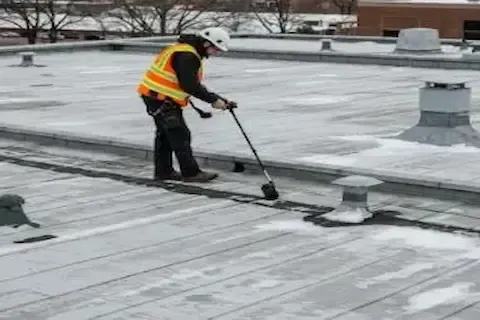
Drone Inspections on Tall Woodbury Office Park Rooftops
When a Woodbury office park sits four or five stories above ground level, even routine rooftop maintenance carries real risk. Sending a crew up a ladder to walk every square foot of a TPO or EPDM membrane takes hours, introduces liability, and can actually damage the surface in the process. Drone inspections have changed that calculus significantly for property managers across the east metro. A skilled operator can cover a large commercial rooftop in a fraction of the time it takes a ground crew, capturing high-resolution thermal and visual data without a single boot touching the membrane.
Why Tall Office Buildings Present Unique Inspection Challenges
The taller the structure, the more variables stack up against a conventional inspection. Wind speed at rooftop level in Woodbury can be substantially higher than at ground level, particularly during spring storm season or the cold fronts that push through the St. Croix River Valley corridor in late fall. Elevated exposure means faster membrane weathering at seams and penetrations. It also means that any moisture that infiltrates through a small blister or unsealed flashing detail has a longer vertical path before it becomes visible inside the building — often showing up in a third-floor ceiling tile months after the damage began.
Conventional inspection schedules typically put a crew on the roof once or twice a year, and that crew is looking for visible defects at eye level. Subtle variations in membrane surface temperature that indicate trapped moisture beneath the surface are nearly impossible to detect that way. A drone equipped with a thermal infrared camera changes what is actually detectable during a single pass.
How Drone Inspection Technology Works on Commercial Rooftops
Thermal drone inspections work best in specific conditions — typically after sunset on a day with significant solar gain, or just before dawn, when the roof membrane has had time to release stored heat unevenly. Areas where moisture is trapped beneath the membrane retain heat longer than dry areas, creating a temperature differential the infrared camera maps in real time. The resulting images show the inspector exactly where suspect areas are, down to a precise grid location on the roof plane.
High-resolution RGB cameras on the same drone platform capture the visual record: membrane surface condition, ponding water outlines, debris accumulation at drains, flashing separations at curbs and HVAC equipment bases, and any areas where the surface has been abraded or punctured. For large office park rooftops in developments like Bailey Road corridor or near Radio Drive, this dual-sensor approach gives property managers a documented baseline they can track year over year.
For property managers who want to understand what a thorough evaluation looks like before committing to a maintenance plan, reviewing what goes into a Commercial Roof Inspection gives useful context on the scope of assessment methods available.
What Drone Data Reveals That Standard Inspections Miss
The practical difference between drone-gathered data and a traditional walk-through shows up in several categories:
- Subsurface moisture mapping: Thermal imaging identifies wet insulation beneath a visually intact membrane, allowing targeted core cuts rather than guesswork.
- Seam and lap condition: Overhead imagery reveals seam lifting patterns across the full roof area, not just the sections a crew happened to walk near.
- Drain performance: Aerial video after a rain event shows exactly which drains are backing up or draining slowly before ponding becomes a structural concern.
- Flashing perimeters: Edge details and parapet cap flashings are difficult to assess from rooftop level but highly visible from drone altitude, especially on tall buildings with complex parapet geometry.
- Documentation for insurance and warranties: Timestamped, geotagged imagery creates a defensible record if a claim is filed or a manufacturer warranty is questioned.
Risk Reduction for Property Managers in the Woodbury Market
Office park owners and property managers in Washington County carry meaningful liability when a roof crew is working on an elevated structure. Drone inspections substantially reduce the number of personnel hours spent at height. In most cases, the drone operator conducts the assessment from ground level or a safe rooftop staging area, with a spotter confirming airspace clearance. The FAA Part 107 certification required for commercial drone operations adds a layer of regulatory accountability that standard roofing inspections do not carry.
Beyond liability, the time savings matter operationally. A 40,000-square-foot office rooftop that might take a two-person crew most of a day to document thoroughly can be assessed by drone in under two hours, with processed imagery available the same afternoon. For a property manager juggling multiple buildings in a campus setting — common in the larger Woodbury office developments along Hudson Road — that efficiency compounds quickly.
Integrating Drone Inspections into a Maintenance Schedule
Drone inspection works best as part of a broader roof asset management approach, not as a standalone event. An annual drone assessment in spring, after winter weather has revealed stress points, pairs well with a focused physical inspection of any flagged areas before the summer heat cycle begins. Fall drone passes, conducted before the first freeze, catch any membrane damage from summer UV exposure or storm activity before ice and snow create access barriers.
Woodbury commercial roof inspections have evolved alongside the technology available to contractors who serve the east metro market. A well-structured program builds a multi-year data set that makes capital planning far more accurate than single-point inspections ever could. Understanding how Woodbury commercial roof inspections are structured across different seasons helps property managers sequence drone passes for maximum diagnostic value.
Choosing the Right Contractor for Drone-Assisted Commercial Roof Work
Not every roofing contractor in the Woodbury area operates drone inspection capability in-house. When evaluating vendors, ask specifically whether the operator holds current FAA Part 107 certification, what camera systems are available (particularly whether thermal infrared is included or costs extra), and how the final deliverable is structured — raw footage is not the same as an annotated inspection report tied to a roof plan.
Contractors with direct experience on the taller office structures common in Woodbury's commercial corridors understand the wind variables, access constraints, and membrane types typically installed on those buildings. That local experience translates into more accurate interpretation of what the imagery shows, and more practical recommendations for any repair or maintenance work that follows.
